
Key Takeaways
Global investment bank Morgan Stanley has set an aggressive target of 10,500 for Korea's stock market. The core driver is a rebound in the memory chip cycle, and investors first need to recognize that the direction of the index is effectively tied to the earnings cycles of just two stocks (tickers): Samsung Electronics and SK Hynix.
More important than the index level itself is the premise underlying this outlook. If the assumption that the semiconductor upcycle extends through the end of next year wavers, the target wavers with it.
What Happened
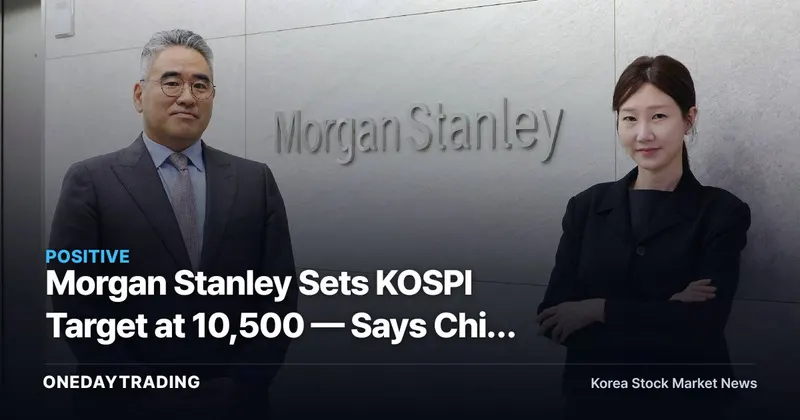
Morgan Stanley's Korea strategy head Jun Seok and economist Kathleen Oh set a KOSPI target of 10,500 points, expecting Korea's chip-driven boom to last through the end of next year. That figure leaves substantial room for further upside relative to the current index level.
Their rationale centers on export momentum. This past May, Korea's exports posted their fastest growth in the last 40 years, and the KOSPI entered record-high territory for the first time ever on June 18. In other words, an export recovery and index strength emerged at the same time.
Background and Context
The backbone of this outlook is the structural fact that semiconductors make up an overwhelming share of Korea's exports. When memory prices rebound, the rise in unit prices feeds directly through to export values and corporate profits — and the interpretation is that demand for high-bandwidth memory (HBM) for AI servers and server DRAM is driving this cycle.
A foreign IB raising its index target is also read as a signal about foreign investors' fund flow. That said, the target is only a scenario that holds if the premise is met — it should be viewed separately from a confirmed path.
Impact on the Market and Stocks
- Samsung Electronics: A core beneficiary, where rising memory unit prices translate directly into operating profit leverage. A significant portion of the index target depends on this stock's earnings estimates.
- SK Hynix: A direct beneficiary of expanding AI demand thanks to its leading position in the HBM market. With a high share of high-value-added products, it has the greatest profit elasticity when the cycle rebounds.
- Semiconductor materials and equipment stocks: Higher memory utilization rates and a capacity-expansion cycle ripple through to downstream demand for back-end and materials companies.
- Large-cap exporters broadly: If strong exports work favorably for the won and for foreign investors' order flow, the warmth can spread to large caps that contribute heavily to the index.
Investor Checkpoints
- Check whether the memory segment's operating margin and HBM revenue share in quarterly earnings releases track the IB's projected path.
- Gauge whether unit-price gains are sustained by watching the monthly trend in DRAM/NAND contract prices (DXI, etc.).
- Watch whether foreign net buying flows and the won/dollar exchange rate are favorable for the supply-demand (order flow) of export stocks.
- Monitor whether AI data center investment (Big Tech capex) guidance is maintained or raised.
Outlook
In the optimistic scenario, AI demand underpins a memory supercycle, lifting exports and the index together. The risks, however, are equally clear. A single IB's aggressive target may already be substantially priced in, creating valuation pressure, and if memory prices turn down earlier than expected or demand slows due to global economic or tariff variables, the premise itself collapses. Rather than chasing the index target, a reasonable approach is to check each quarter whether the earnings and unit-price indicators that support that target are actually being confirmed.
This article is content automatically summarized and analyzed based on the original news. View original (Maeil Business Newspaper, Corporate)