
Key Takeaways
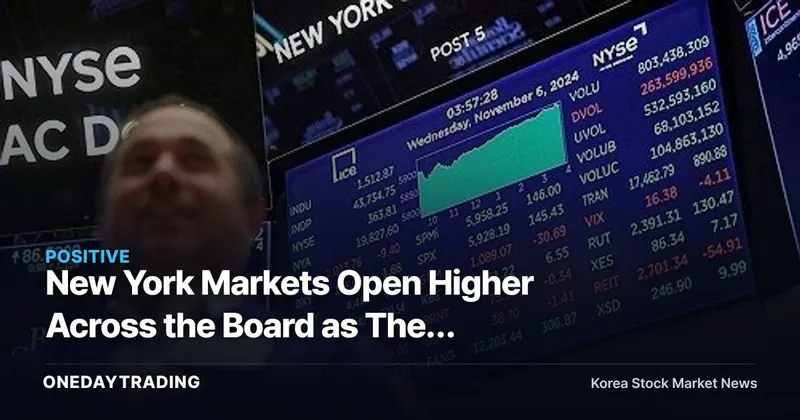
Immediately after the release of the nonfarm payrolls report, all three major New York indices opened higher in tandem. This suggests the data was absorbed smoothly without shocking the market, indicating that the existing consensus on the Federal Reserve's rate path was not significantly shaken. For domestic investors, this can be read as a clue to the next direction of the KRW/USD exchange rate and KOSPI supply-demand (order flow).
What Happened
The three major New York indices (the Dow Jones Industrial Average, the S&P 500, and the Nasdaq Composite) all opened higher after digesting the nonfarm payrolls data released by the U.S. Department of Labor. Employment data typically triggers sharp swings in index futures right after release, but this time buying interest actually flowed in as the market absorbed the figures. This can be read to mean that the report did not overturn the market's pre-priced scenario — that the labor market continues on a path of gradual cooling, neither overheating nor freezing over.
Had the data surprised significantly, government bond yields and the dollar index would have swung first, with stock prices following. The higher open itself is close to evidence that the bond market did not treat this report as an event requiring a recalculation of the rate-cut timeline.
Background and Context
In recent sessions, the New York market has been weighing rate-cut expectations against every employment and inflation reading. It's a dilemma zone: if the data comes in stronger than expected, the rate-cut timeline gets pushed back, pressuring growth-stock valuations; if it comes in weaker, concerns about an economic slowdown intensify. A digest-and-rally pattern like this one is the typical reaction that emerges in the middle ground — when the data lands within the existing outlook range without a clear directional signal.
Impact on Markets and Stocks (Tickers)
- Growth-stock re-rating if government bond yields stay stable: If the employment data doesn't shake the rate-cut path, the discount-rate burden eases, helping Nasdaq-centered tech stocks sustain their multiples — a dynamic that could also work favorably for the supply-demand (order flow) of large-cap domestic semiconductor names Samsung Electronics (005930) and SK Hynix (000660).
- KRW/USD exchange rate path: If the U.S. market's gains are accompanied by dollar weakness, the incentive for foreign investors to flow into the KOSPI increases; conversely, if the dollar stays strong while only U.S. stocks rise, the boost to domestic supply-demand (order flow) will be limited.
- Mixed picture for financial stocks (tickers): If rate-cut expectations persist, the pace of net interest margin improvement at bank stocks (tickers) may slow, but as cuts become more visible, the burden of provisioning for credit losses tends to ease — a two-sided effect.
- Export stocks (tickers): If this is read as a signal that U.S. consumer strength is holding up, it could serve as a positive catalyst for industry sectors with heavy exposure to U.S.-bound exports, such as automobiles and home appliances.
Investor Checkpoints
- Check whether the dot plot and rate-path commentary from committee members at the next FOMC meeting align with this reading of the employment data.
- Watch which direction the U.S. 10-year Treasury yield and the dollar index converge toward in the days following the jobs report.
- Gauge the direction of foreign investor supply-demand (order flow) by watching whether the KRW/USD exchange rate retests the high-1,300s level.
- Check the schedule for the next CPI and PCE inflation readings to reassess whether rate-cut expectations hold.
Outlook
If the pattern of smoothly digested employment data continues, the market may lend more weight to the existing scenario of a soft landing amid gradual cooling. In that case, rate-cut expectations would likely persist, sustaining a favorable environment for both growth stocks and KOSPI supply-demand (order flow). That said, the risk that this higher open turns out to be a one-day relief rally cannot be ruled out. If wage growth or the unemployment rate falls outside the expected range in subsequent data, pressure to recalibrate the rate path could resurface and volatility could rise again — a balanced point worth keeping in mind.
This article is automatically summarized and analyzed content based on the original news report. View Original (Yonhap News Agency, Securities)