
3-Line Briefing
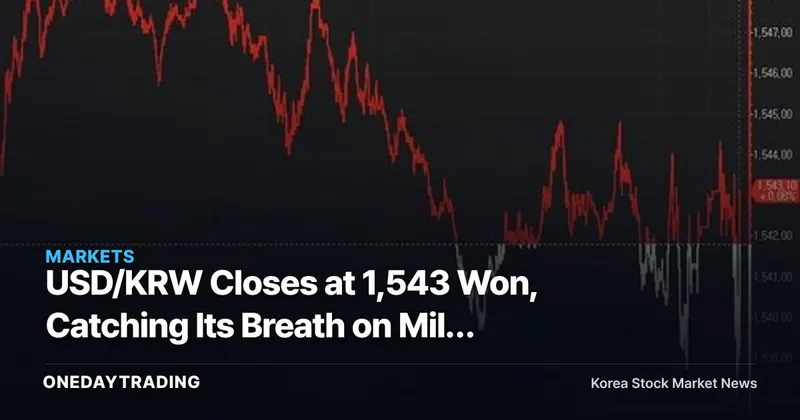
- USD/KRW closed at 1,543.10 won in overnight trading, catching its breath after a steep climb.
- Mild U.S. PCE inflation eased fears of further rate hikes, taking some pressure off dollar strength.
- A high exchange rate in the 1,540-won range is favorable for auto and semiconductor exporters, but acts as a cost burden for airlines and refiners that buy raw materials and fuel in dollars.
What's Changing
The key to this move is that the variable likely to change direction is not the exchange-rate level itself, but U.S. inflation and the Fed's path. With U.S. personal consumption expenditures (PCE) inflation confirmed as mild and not far from market expectations, the expectations for further tightening that had been lifting the dollar cooled a notch. As a result, the won—which had slid into the high-1,540s—stopped weakening further and appears to be finding balance around 1,543 won.
Still, it is too early to read this pause as a trend reversal. The very fact that the exchange rate is holding in the 1,540-won range shows that the won's structural weakness has not been resolved. The mild PCE is merely a factor capping the dollar's near-term upside; the won will strengthen meaningfully only when the larger axes—the Korea-U.S. rate gap, the trade balance, and foreign investors' fund flow—turn around.
What matters to investors is that a high exchange rate creates opposite profit-and-loss outcomes by industry sector. Companies that receive a large share of revenue in dollars see their translated profits rise, while companies that pay for crude oil, equipment, and jet fuel in dollars see their costs swell directly.
Reading the Numbers in Context
The closing rate of 1,543.10 won is a historically very high level, beyond the phase when 1,500 won was under threat. The more the exchange rate becomes entrenched in this range, the more FX gains add to the quarterly earnings of large exporters—but at the same time, it stokes import prices, returning as a burden for domestic-demand and consumer stocks. The essence of this exchange-rate phase is that the same 1,543 won is margin for some and cost for others.
Beneficiary and Affected Stocks
- Samsung Electronics & SK hynix: With a high share of semiconductor exports, the won value of their dollar revenue grows. A high exchange rate is favorable on both price competitiveness and FX gains.
- Hyundai Motor & Kia: Auto exporters with a large share of North American sales—a representative beneficiary sector whose per-unit translated profit expands when the won weakens.
- Korean Air & Asiana: With jet-fuel payments and foreign-currency debt denominated in dollars, a high exchange rate is an adverse factor that simultaneously inflates fuel costs and FX translation losses.
- Refiners & Chemicals (S-Oil, SK Innovation): Crude import prices are set in dollars, so costs rise, but the exchange rate is also reflected in export product prices, leaving profit and loss mixed.
- Domestic-demand & Retail stocks: Rising import costs squeeze margins and dampen consumer sentiment, leaving them relatively disadvantaged.
Risk Check
- The risk of over-interpreting a mild PCE. If the next inflation or employment data comes in strong, the dollar could jump again and push the won into the 1,550-won range.
- High-exchange-rate benefits lean heavily on translated profits, so if the exchange rate reverses quickly, earnings expectations could fade along with it.
- If the authorities' FX market intervention or verbal warnings intensify, the exchange-rate momentum for exporters could weaken in the short term.
- If the high exchange rate stokes import prices and delays the timing of rate cuts, it becomes a headwind for domestic-demand and growth stocks across the board.
Bottom Line
The mild PCE cooled the dollar's near-term overheating, but the won's structural weakness remains intact. As the exchange rate serves as a support for exporters' earnings while cost pressure continues for airlines and domestic demand, this is a zone to monitor alongside the next U.S. inflation data and whether the 1,540-won line holds.
This article is content automatically summarized and analyzed based on the original news. View Original (Yonhap News)