
At a Glance
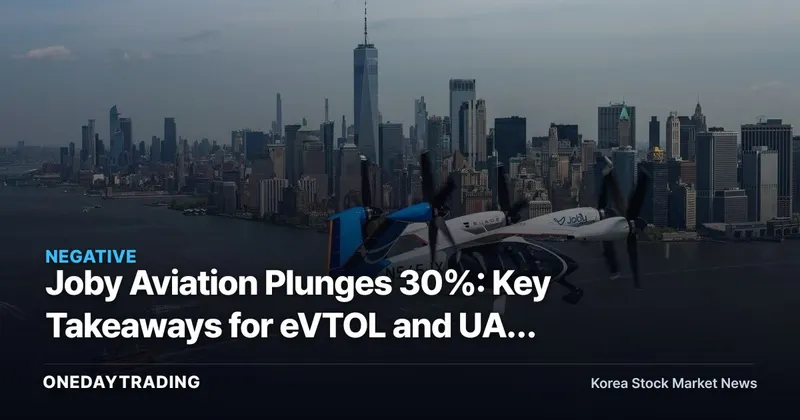
Shares of Joby Aviation (JOBY), the bellwether of U.S. Urban Air Mobility (UAM), have plunged roughly 30% from their peak, fueling broader skepticism toward the entire eVTOL theme. The move stems from a combination of profit-taking after a short-term surge and the volatility characteristic of growth stocks with no earnings to speak of—it reflects a valuation reset rather than a collapse of the business itself. This trend ties directly into investor sentiment around related Korean UAM stocks such as SK Telecom and Hyundai Motor.
Why It Matters Now
Joby is a textbook pre-revenue growth stock whose share price moves on certification and mass-production expectations alone, with virtually no revenue. Such stocks surge on a single line of positive catalyst, and when interest rates, liquidity, or sentiment wobble, they can shed double-digit percentages without any change in fundamentals. That is precisely why a 30% drop does not necessarily signal business failure—and equally why it is hard to declare a bottom.
The crux lies between two swinging pendulums. One is progress on the U.S. Federal Aviation Administration (FAA) Type Certification and the timing of the first commercial flight; the other is the pace of cash burn and the possibility of additional capital raises (dilution). eVTOL involves a long, capital-intensive certification process, so even a single quarter of delay amplifies share-price volatility. In a 30% plunge, what investors should check is not price but the substantive metrics—certification, cash flow, and order bookings.
For Korean investors, Joby is not some foreign stock with no bearing on them. Because SK Telecom has taken an equity stake in Joby and has collaborated on domestic K-UAM demonstration projects, Joby's timeline and reputation carry over directly into sentiment across the Korean UAM value chain.
Frequently Asked Questions
- Why did it drop as much as 30%? Rather than an earnings-driven negative catalyst, the move was largely driven by the unwinding of short-term overheating in a revenue-less growth stock, compounded by profit-taking and a pullback in sentiment.
- Is this a sign the business has failed? That's hard to argue. As long as the certification process and partnerships remain intact, the decline looks closer to a valuation adjustment. Cash burn, however, is a separate risk.
- Is now a buy-the-dip opportunity? The size of the drop may look attractive, but with profitability still far off, tolerance for volatility is a prerequisite.
- What's the domestic impact? UAM-related stocks such as SK Telecom and Hyundai Motor may show short-term thematic correlation in sentiment.
Impact on Related Stocks and Sectors
- Joby Aviation The direct subject of the issue. With eVTOL certification and commercialization expectations accounting for nearly all of its share price, it is the most sensitive to timeline variables.
- SK Telecom As an equity investor in Joby and a K-UAM collaboration partner, its domestic UAM business expectations are linked to Joby's timeline and reputation.
- Hyundai Motor Developing its own eVTOL through subsidiary Supernal, it moves in step with the strength or weakness of the global UAM theme.
- Hanwha Systems Holding UAM investments such as Overair along with avionics businesses, it is exposed to swings in sector sentiment.
- Korean Air Through participation in UAM flight and traffic-control consortiums, it is positioned to benefit or suffer indirectly from commercialization progress.
Points to Watch Before Investing
- As a pre-revenue stage company with negligible revenue, its valuation basis is weak, and the share price reacts hypersensitively to the interest-rate and liquidity environment.
- If cash burn is rapid, paid-in capital increases or convertible bond issuance could dilute shares and deepen the decline.
- Delays in FAA certification and mass-production timelines are a recurring risk across the entire eVTOL industry sector.
- Related Korean stocks are driven more by thematic correlation than by actual revenue contribution, so volatility is high when momentum fades.
Overall Outlook
The bullish scenario is clear. If the Type Certification process proceeds on schedule and the first commercial flight and new orders come into view, the 30% drop could be re-evaluated as an entry zone. UAM is a long-term growth theme accompanied by policy and infrastructure, so it is hard to deny the direction itself. The risks on the other side are just as clear. The path to profitability is long, and in the meantime, dilution from capital raising and timeline delays could pressure the share price again. The checkpoints are not price but the quarterly cash burn rate in earnings, FAA certification milestone disclosures, and progress announcements on SK Telecom's and Hyundai Motor's UAM businesses. Only when all three improve simultaneously will there be grounds for a trend reversal.
This article is content automatically summarized and analyzed based on an original news report. View Original (Yahoo Finance)