
Key Takeaways
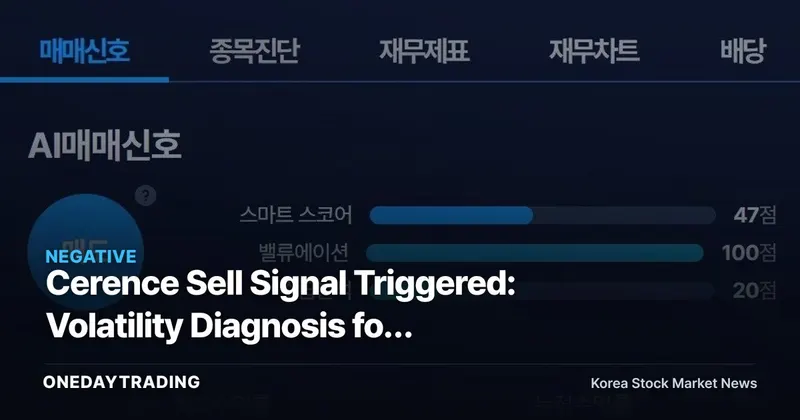
An AI-driven trading model has issued a sell signal on Cerence (CRNC), a provider of automotive AI voice solutions, with the signal-based return recorded at 16.24%. More important than the signal itself is what this stock (ticker) reveals: it serves as a concentrated expression of the volatility inherent in the autonomous driving and automotive software theme stock space. Now is the time to assess whether the stock has entered a profit-taking phase following a sharp gain (surge).
What Happened
Cerence develops voice assistant and conversational AI software embedded in automotive infotainment systems, supplying its technology to global automakers. The sell signal in question is triggered when specific technical or momentum indicators suggest overheating or a deceleration in trend — in essence, it acts as a mechanism for locking in prior gains.
Notably, Cerence's share price has exhibited significant volatility, moving in tandem with generative AI sentiment and the software-defined vehicle (SDV) trend. While a sell signal does not necessarily imply deteriorating fundamentals, it serves as a warning that theme stocks (tickers) with high sensitivity to narratives tend to see sharper reversals following such signals.
Background and Context
The automotive AI voice market carries structural growth expectations tied to the SDV transition. However, since Cerence's revenue is linked to automaker production and sales cycles, a slowdown in upstream automotive demand directly pressures its royalty and license revenue. An additional variable is the threat of intensified competition should Big Tech's general-purpose voice AI expand into the vehicle domain.
Market and Stock Impact
- Cerence (CRNC): The sell signal indicates short-term momentum deceleration. If vehicle sales and order flows weaken, slowing license revenue becomes a downside factor for the share price.
- Hyundai AutoEver: The company operates in automotive software and infotainment platforms, sharing the SDV theme stock narrative, but its stable in-group upstream demand gives it a different volatility profile.
- NVIDIA: As a chip supplier handling AI computing for vehicles, NVIDIA is exposed to the same directional trends in automotive AI demand, but its far broader application base limits the impact of any single signal.
- Automotive industry sector: Vehicle unit sales are the key upstream variable for AI voice software revenue, meaning a slowdown in auto demand flows through to related software companies with a lag.
Investor Checkpoints
- In the next quarterly earnings report, track the growth rate of license and royalty revenue and the per-vehicle unit pricing trend.
- Monitor new OEM contract announcements to assess the quality of upstream demand.
- Watch trading volume following the sell signal to determine whether profit-taking represents a trend reversal or a short-term correction.
- Keep an eye on competitive dynamics, including news of Big Tech entering the automotive voice AI space.
Outlook
If the SDV transition continues, rising penetration of automotive AI voice software could expand the mid-to-long-term revenue base. That said, the structural dependence of revenue on the automaker cycle, competitive pressure from general-purpose voice AI, and the valuation volatility typical of theme stocks remain headwinds even after the signal. Rather than equating a short-term signal-based return with fundamental improvement, a more prudent approach is to reconfirm the trend through actual earnings and order data.
This content was automatically summarized and analyzed based on the original news article. View Original Article (MK Securities)