
At a Glance
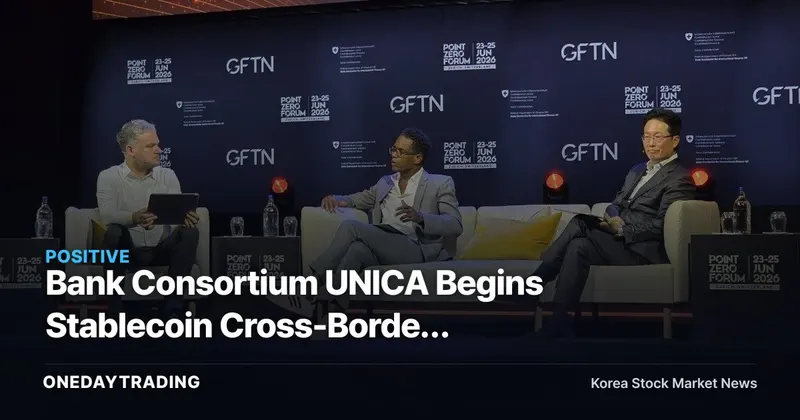
UNICA, a consortium of domestic banks, has joined forces with Europe's stablecoin payment project Pangea to validate cross-border remittances and foreign exchange transactions on the blockchain. The pilot, which involves some 10 financial firms including Shinhan and NH, is significant as an attempt that could shake up the speed and cost structure of the existing SWIFT network. That said, it should be viewed separately that the current stage is one of validation rather than commercialization.
Why It Matters Now
For investors, the significance of this news lies not in being a mere announcement of new technology adoption, but in showing the potential for a shift in banks' profit structures and in leadership over payment infrastructure. Cross-border remittances have until now passed through SWIFT, accumulating multiple intermediary banks, settlement delays of several business days, and considerable fees. Stablecoin-based on-chain settlement has the potential to compress these intermediary steps, cutting settlement time to a matter of minutes and lowering costs — introducing variables into both banks' FX and remittance fee income and their methods of fund management.
In particular, the fact that SWIFT is pursuing payment-network innovation together with blockchain infrastructure such as Kibalis and Chainlink suggests that this trend has moved beyond an experiment within the crypto industry into a competition over institutional payment standards. The area handled by Chainlink involves the data and messaging connectivity that bridges on-chain and existing financial networks, serving as the conduit through which banking systems accept blockchain settlement. The fact that Fair Square Lab handles on-chain foreign exchange transactions domestically falls within the same context — a stage of validating a structure in which FX quotes and execution take place on the blockchain.
From Korea's standpoint, a more important variable is that this is intertwined with the debate over institutionalizing a won-denominated stablecoin. If the bank consortium first accumulates experience in cross-border payment pilots, it can secure an advantageous position in the future competition for leadership over the issuance of won-based digital currencies and stablecoins.
Frequently Asked Questions
- What is UNICA? It is a banking-sector consortium formed jointly by several domestic banks to validate the digital and blockchain payment space, reportedly involving some 10 financial firms including Shinhan and NH.
- What kind of project is Pangea? It is a stablecoin payment project being pursued by the European financial sector, with SWIFT, Kibalis, and Chainlink among those participating in payment-network innovation.
- Will remittances get faster right away? No. This is currently a pilot stage confirming the technical feasibility of cross-border remittances and FX transactions, and additional time is needed before commercialization and regulatory approval.
- Is this good or bad for bank profits? It cuts both ways. Leadership over new payment infrastructure is an opportunity, but remittance and FX intermediary fees themselves could shrink over the long term.
Related Stocks & Sector Impact
- Banks & Financial Holding Companies Shinhan Financial Group is named directly as a participant in the pilot, giving it the most direct relevance in terms of accumulating experience in the new cross-border payment business.
- Major Financial Holding Companies Hana Financial Group, KB Financial, and Woori Financial Group also fall within the impact zone of this payment paradigm shift, given their large FX and remittance exposure.
- Electronic Payments & Fintech Payment operators such as Kakao Pay would face both opportunity and competitive pressure in new payment and remittance areas if stablecoin settlement spreads.
- Blockchain Infrastructure Theme If demand for on-chain FX and payment connectivity grows, the order base for related software, security, and infrastructure firms could widen.
Points to Watch When Investing
- The current stage is validation and piloting, and there is a significant time lag before it translates into revenue or profit. It is hard to expect this to be reflected in earnings in the short term.
- The regulatory direction is a variable for stablecoins and digital currencies. If the timeline for institutional adoption at home and abroad is delayed, the pace of commercialization will slow along with it.
- Remittance and FX fees could be compressed over the long term, so the benefit from greater efficiency and the decline in fee income should be weighed together as potentially offsetting.
- Stocks that have posted short-term sharp gains (surge) on theme expectations alone may accumulate valuation burden, so they should be checked separately from the facts of actual participation and contracts.
Overall Outlook
On the optimistic side, the very fact that institutional banks are moving together with SWIFT, Chainlink, and others raises the realism of stablecoin payments. Domestic banks that conduct validation ahead of others could strengthen their voice in standard design in the future won-stablecoin and digital payment markets. In the opposite scenario, there is a risk that commercialization will be delayed longer than expected, with delays in regulatory consensus, competition over technical standards, and conflicts with the existing fee model overlapping. In the end, the indicators to watch are clear. It is reasonable to track the release of pilot results and disclosures of additional participating institutions, the timeline for regulatory decisions related to the won-stablecoin, and the trend in banks' FX and remittance fee income through quarterly earnings, thereby checking on the progress of commercialization.
Shinhan Financial Group Through Real-Time Data
Shinhan Financial Group's latest closing price is 97,700 won (+0.21% vs. the previous day), and the traffic-light signal — combining foreign and institutional investor supply-demand (order flow) with news and momentum — is 🟢 Buy Bias. With foreign investors and news being positive, it is worth paying attention to.
- ▲ Order Flow Continuity — Foreign investors net buyers for 4 consecutive days (+13.8 billion won)
- ▲ News Flow — 6 positive catalysts vs. 0 negative catalysts — positive catalysts dominate
Recent related news is favorable, with 6 positive catalysts and 0 negative catalysts.
※ Price and foreign/institutional investor supply-demand (order flow) data are provided by Korea Investment & Securities (KIS), as of the time of publication.
This article is content automatically summarized and analyzed based on the original news. View Original (Maeil Business Newspaper, Securities)