
Summary
The UK is accelerating development of a long-range missile that is cheaper to produce than the existing Storm Shadow cruise missile and that reduces dependence on US components. The key takeaway is not simply the arrival of a new weapon, but two converging trends: the de-Americanization of the weapons supply chain and value-for-money competition. This is a variable that directly shakes the competitive landscape for Korean defense companies, which have built their edge on exporting non-US, mid-priced weapons.
What Happened
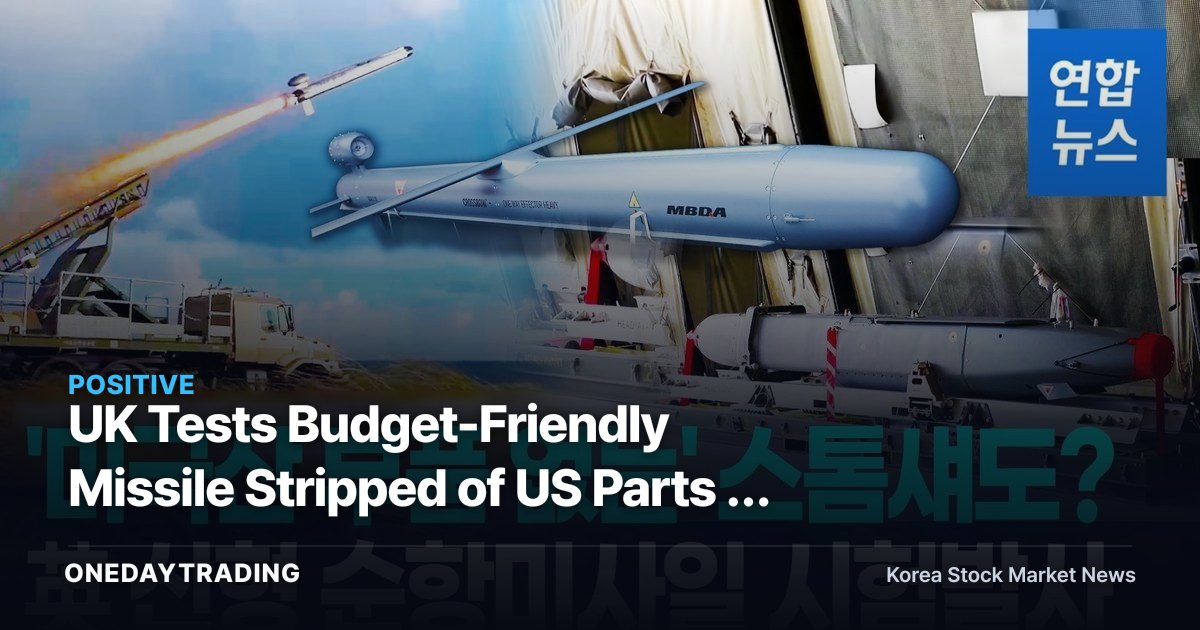
The UK is developing a new missile to replace and complement the Storm Shadow (known as SCALP in France), the long-range air-to-surface cruise missile it has long operated, and recently appeared to be picking up the pace—even releasing footage of a launch test. The new missile has two clear design goals. One is to lower production costs versus existing models, making mass production and post-use replenishment easier; the other is to exclude US-made components and create a weapon free from US export controls (such as ITAR).
This direction aligns with the lessons of the war in Ukraine. As precision-guided munitions were consumed faster than expected, the concept of volume—stockpiling enough weapons with adequate performance—has regained importance over holding small quantities of high-performance, high-cost weapons. In addition, the fact that any inclusion of US components requires US approval for each third-country export, constraining sales autonomy, has long been a concern for European defense.
Structural Backdrop
The keywords in the global defense market right now are rearmament and supply-chain sovereignty. As European nations raise defense spending, demand itself has grown, while at the same time the push toward self-armament to reduce US dependence is strengthening. Within this, Korean defense has penetrated European markets such as Poland with a value-for-money positioning of adequate performance, reasonable pricing, and fast delivery. The UK's latest attempt shows that this value-for-money and localization competition is spreading into precision-weapon domains like missiles as well.
Stock and Sector Ripple Effects
- LIG Nex1: With guided weapons and missiles such as Hyunmoo, Haeseong, and Cheongung as its mainstay, it overlaps most directly with the expansion in precision-guided weapon demand that this issue points to. That said, there is a double edge: if value-for-money competition intensifies, pressure on price and delivery timelines grows in tandem.
- Hanwha Aerospace: As the defense sector bellwether holding firepower systems such as the K9 self-propelled howitzer and Chunmoo, plus engine and aerospace divisions, it is a key conduit for European rearmament benefits. Its direct missile exposure is relatively small, but it serves as a barometer for overall market momentum.
- Korea Aerospace Industries (KAI): With FA-50 export expansion potentially driving accompanying demand for weapons integration, there is a possibility of indirect benefit.
- Hyundai Rotem: Through exports of ground equipment such as the K2 tank, it falls within the beneficiary zone of rising European defense budgets.
- Defense parts and materials suppliers: The weapons localization trend can grow demand for in-housing core components such as guidance units, propulsion systems, and sensors, potentially serving as an opportunity for small and mid-sized suppliers.
Bull vs. Bear Scenarios
On the bull side, the standout point is that Europe's rearmament and the trend of reducing US dependence structurally grow demand for non-US weapons suppliers. Korean defense, with its proven value-for-money and fast mass-production capacity, has room to be cited as a candidate to fill that gap.
Conversely, the bear scenario is also clear. If the UK and Europe directly boost the value-for-money and localization of their own weapons, the price advantage Korea has enjoyed could be diluted, and pressure to demand local production and technology transfer could intensify. The valuation burden of defense stocks that have already risen sharply, and the time lag before order wins are actually booked as revenue and profit, are also variables.
Investor Action Points
- Check the defense-budget increase announcements of major European nations and their missile and precision-guided weapon procurement plans on a quarterly basis.
- At the next earnings releases from LIG Nex1 and Hanwha Aerospace, verify trends in order backlog and overseas share.
- Examine whether disclosures of large export contracts and MOUs come with price competition or local production conditions (margin impact).
- Given the already elevated valuation of the defense sector, also watch for any gap between momentum and earnings.
LIG Nex1 Through Real-Time Data
LIG Nex1's latest closing price is 852,000 won (-3.62% versus the previous day), and the signal light combining foreign and institutional investor order flow with news and momentum is 🟡 Neutral / Wait-and-See. Positive and negative signals are mixed, making this a zone to watch.
Recent related news is favorable, with 2 positive catalysts and 0 negative catalysts.
※ Price and foreign/institutional investor order-flow data are provided by Korea Investment & Securities (KIS), as of the time of publication.
This article is content automatically summarized and analyzed based on the original news. View original (Yonhap News, Industry)