
Summary
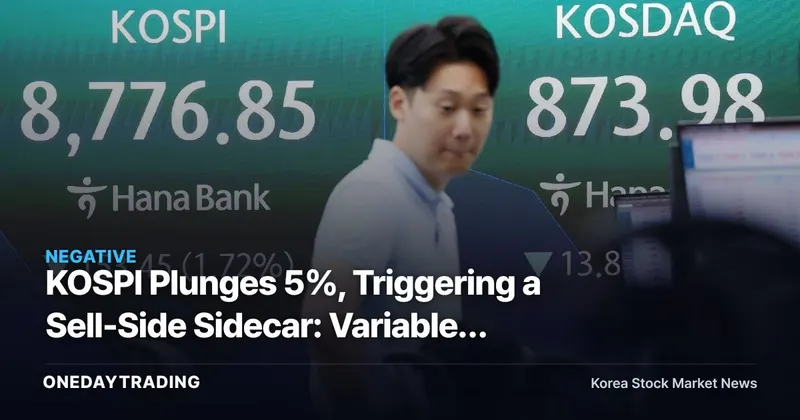
The KOSPI plunged 5% intraday, prompting the Korea Exchange (KRX) to trigger a sell-side sidecar on the stock market. This is a signal that risk aversion across the entire market kicked in simultaneously, rather than a negative catalyst tied to a single stock (ticker). Large-cap stocks with heavy index weighting and export stocks sensitive to foreign investor order flow sit at the epicenter of the volatility.
What Happened
When the KOSPI index plunged by around 5% on the morning of the 26th, the exchange triggered a sell-side sidecar at 11:12 a.m., temporarily suspending the validity of sell quotes from program trading. A sidecar is a buffer mechanism designed to prevent program trading from amplifying declines in the cash market when futures prices swing beyond a set threshold, halting the validity of sell-side program quotes for five minutes.
A sidecar itself is one step milder than a circuit breaker, which halts trading entirely. However, the fact that it was triggered means investor sentiment cooled so abruptly that arbitrage and non-arbitrage program selling flooded the futures market all at once. Typically in such phases, simultaneous selling by foreign investors and institutional investors, sharp swings in the exchange rate, and concerns over margin and forced liquidation tend to overlap, further amplifying volatility.
Structural Background
The KOSPI is heavily weighted toward large-cap export stocks such as semiconductors, automobiles, and secondary batteries, making the entire index prone to moving in sync with global risk-asset aversion or with exchange-rate and interest-rate variables. Because a handful of top names by market capitalization carry overwhelming weight, when program selling concentrates on these stocks, the index's decline deepens rapidly and stabilization mechanisms such as sidecars and circuit breakers can be triggered in a chain reaction.
Stock and Sector Ripple Effects
- Samsung Electronics and SK Hynix (semiconductors): With the largest index weighting and a high proportion of foreign ownership, these are the key variables driving the index's decline when program selling and foreign investor outflows overlap.
- Hyundai Motor and Kia (auto export stocks): Highly sensitive to the exchange rate and the global economy, they easily become targets of foreign investor selling in a risk-aversion phase.
- Large-cap secondary battery stocks: As growth stocks, they carry a heavy high-valuation burden, so their declines can be relatively deeper in volatile markets.
- Brokerage stocks: A surge in trading value is favorable for short-term earnings, but if the plunge drags on, margin and forced-liquidation risks come to the fore.
- KOSDAQ small- and mid-cap stocks: With a high proportion of margin loans, a chain reaction of forced liquidations could make their volatility greater than that of large-cap stocks.
Bull vs. Bear Scenarios
In the bear scenario, if further declines follow the sell-side sidecar, the decline could deepen amid the possibility of a circuit breaker being triggered, a vicious supply-demand (order flow) cycle from margin-driven forced liquidations, and a sharp gain (surge) in the exchange rate. Conversely, in the bull (rebound) scenario, it is not uncommon for the sidecar to function as a short-term oversold signal, drawing in bargain hunting and program buying that quickly recovers the decline. As volatility has historically been large in both directions immediately after a sidecar is triggered, it is necessary to check supply-demand (order flow) together with external variables rather than to assume a single direction.
Investor Action Points
- Check whether foreign investors and institutional investors turn to net program buying in the afternoon session and whether the futures basis recovers.
- Monitor the won-dollar exchange rate alongside U.S. index futures movements to distinguish whether the plunge stems from domestic or external factors.
- For stocks with high margin balances, check forced-liquidation risk first, and refrain from reckless chase-buying during phases of expanding volatility.
- Organize calendar-driven variables in advance, such as the exchange's additional stabilization measures on the next trading day and the schedules for monetary policy and key indicators in major economies.
This article is content automatically summarized and analyzed based on the original news report. View original (Maeil Business Newspaper, Securities)