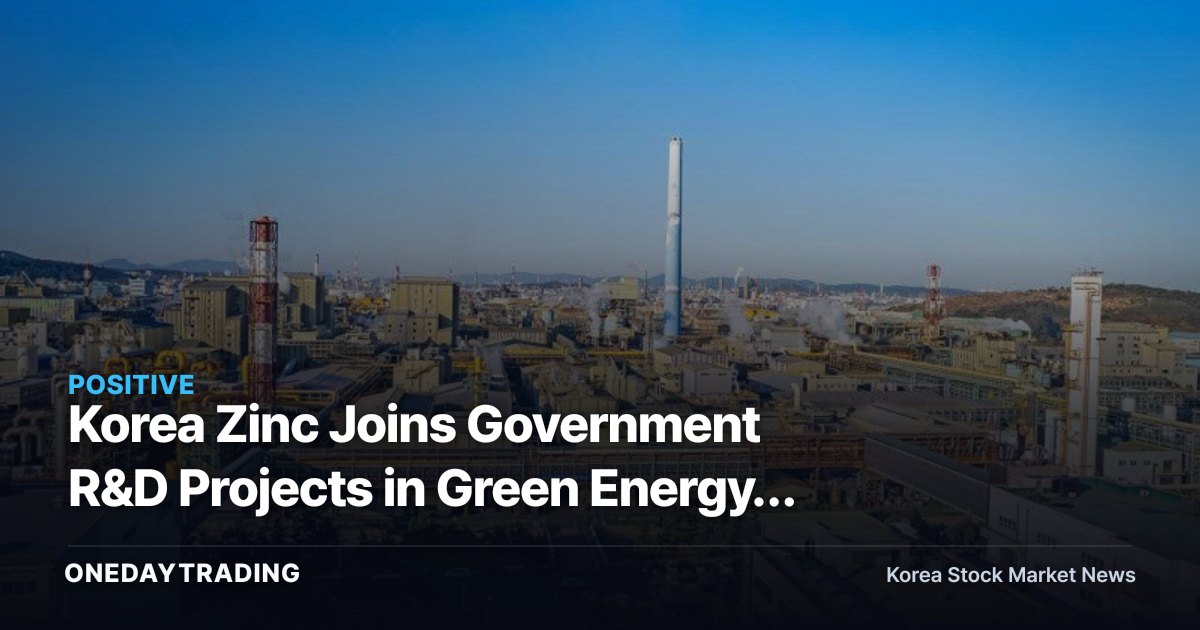

Korea Zinc's participation in this government R&D project is not merely news of research cooperation. Rather, it reads as a signal that a non-ferrous metals company once confined to its core smelting business is shifting its strategic axis toward high-value-added material areas such as battery materials and rare earths. The key point is that the company's existing smelting and refining process capabilities overlap substantially with next-generation material processes such as cathode precursors for secondary batteries, copper foil, and rare earth separation and refining. In other words, the company has room to lead new entrants — who would have to build new facilities from scratch — on the cost and process learning curve, and the government project means part of the initial cost and technological risk of that transition is being shared. What investors should focus on is not the R&D itself, but the utilization rates and profitability of the material lineups at subsidiaries such as Kemco and ISTMC, where these projects translate into actual revenue.
3-Line Briefing
- Korea Zinc is carrying out government R&D projects in green energy, battery materials, and rare earths in partnership with industry-academia-research institutions.
- This is interpreted as a mid-to-long-term move to expand its core non-ferrous metals smelting capability into domestic material production and supply-chain self-sufficiency.
- Rare earth and battery material self-sufficiency is a policy-beneficiary theme, but it will take time and capital investment before it contributes to earnings.
What Is Changing
Korea Zinc has built up top-tier global competitiveness in the smelting of non-ferrous metals such as zinc, lead, and silver. This project participation is an attempt to transform its downstream industries on top of that foundation. Green energy, battery materials, and rare earths are all areas the government is pushing for domestic production as part of supply-chain security, and joint industry-academia-research research serves as a channel to accelerate technology acquisition and lower the initial burden with government funding.
Rare earths in particular are essential — via permanent magnets — to electric vehicle motors, wind turbines, and defense components, yet their separation and refining processes are demanding and the items are heavily dependent on specific countries. Given that the wet and dry refining know-how held by smelting companies can be applied to rare earth separation, there is a technological link between Korea Zinc's core business and its new ventures. Battery materials likewise dovetail with the group's ongoing precursor and copper foil businesses, providing a path for R&D results to flow into subsidiary operations.
By the Numbers and Context
That said, this report did not present specific figures such as the scale of the projects, the amount of government funding, or target timelines. At this stage, therefore, it is reasonable to view this as information confirming the company's business direction rather than as a catalyst with an immediate impact on earnings. Investors should separately track the point at which the project results materialize into operating performance — such as nickel sulfate and precursor lines at the subsidiary Kemco, or production at the copper foil subsidiary.
Beneficiary and Affected Stocks
- Korea Zinc: The project lead and the central party expanding its smelting capability into materials and rare earths. Its core-business cash flow becomes the funding source for new ventures.
- Young Poong: An affiliate intertwined with Korea Zinc through smelting and shareholding structures, placing it directly and indirectly within the sphere of influence of this business shift.
- POSCO Future M and L&F: If the trend toward domestic production of cathode materials and precursors strengthens, it becomes a factor reshaping the competitive and cooperative dynamics within the material value chain.
- Sunglim Advanced Industry and related permanent magnet stocks: As domestic production of rare earth separation and refining advances, it affects the stability of the downstream magnet manufacturing supply chain.
Risk Check
- R&D projects can take years to reach commercialization and revenue, so their contribution to near-term earnings is limited.
- Battery materials and rare earths require large-scale capital investment, so core-business profits may be diverted into new-venture spending.
- A slowdown in EV demand or swings in metal prices are variables that could shake the profitability of the new ventures.
- Rare earth separation faces high technological and environmental regulatory barriers, raising the possibility of delays to target timelines.
One-Line Conclusion
The direction of materials and rare earth self-sufficiency that adjoins its core smelting business carries both a policy-beneficiary angle and a long-term growth story, but this is a phase in which the time to profit visibility and the investment burden must be weighed together.
Korea Zinc Through Real-Time Data
Korea Zinc's latest closing price is 1,209,000 won (-4.12% from the previous day), and its signal light — combining foreign and institutional investor supply-demand (order flow) with news and momentum — is 🟡 Neutral / Wait-and-See. With positive and negative signals mixed, it is a zone to watch.
Recent related news is favorable, with 2 positive catalysts and 0 negative catalysts.
※ Price and foreign/institutional supply-demand (order flow) data are provided by Korea Investment & Securities (KIS) and are as of the time of publication.
This article is content automatically summarized and analyzed based on the original news. View original (Maeil Business Newspaper, Corporate)