
Key Takeaways
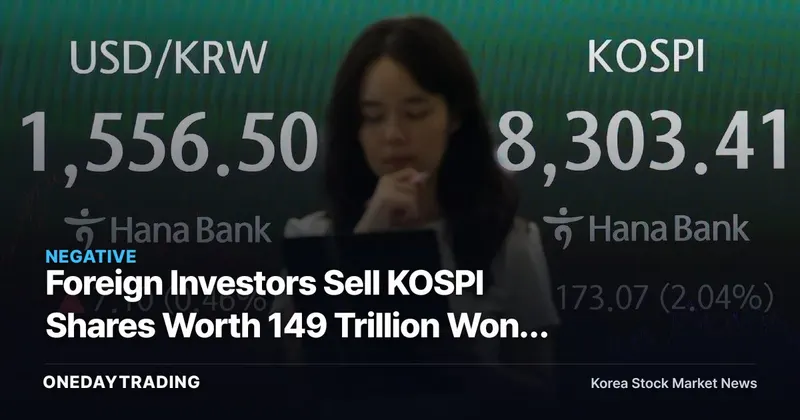
Foreign investors posted net selling of more than 149 trillion won on the KOSPI in the first half of this year. On one single day, net selling approached an all-time high of 7.8 trillion won. Retail investors bought almost exactly enough to offset that outflow—99 trillion won—yet foreign ownership ratios in both Samsung Electronics and SK Hynix fell in tandem. This is not just a supply-demand (order flow) statistic; it signals a shift in who is actually underpinning KOSPI large-cap stocks.
What Happened
The 149-trillion-won figure is not a one- or two-day swing but a cumulative total built up over half a year. The fact that it includes a single-day record net-selling figure of 7.8 trillion won suggests this wasn't event-driven selling but a broader shift by benchmark-tracking funds to reduce their KOSPI weighting. The fact that retail investors absorbed 99 trillion won doesn't mean the market found balance—a gap of roughly 50 trillion won remains between net selling and net buying, and that gap has ultimately been bridged by share prices themselves.
What stands out even more is the decline in foreign ownership of Samsung Electronics and SK Hynix. Both stocks rank among the largest by market capitalization on the KOSPI and carry the heaviest weightings in major indices such as MSCI. That means when foreign capital pulls back from the KOSPI as a whole, these two stocks (tickers) are typically sold first and hardest. This points less to a company-specific view on the semiconductor cycle and more to mechanical, index-driven selling shaking up supply-demand (order flow) in both names.
What matters here is not price but valuation. Foreign investors typically sell the KOSPI for one of two reasons: to avoid FX losses on an expected weaker won, or because they judge the KOSPI's relative valuation appeal has faded compared with other markets. The current situation looks like a classic case of both factors overlapping. What the market has already priced in is expectations for improved earnings at Samsung Electronics and SK Hynix; what remains unpriced is when foreign capital will turn back to net buying.
Background and Context
Retail investors' 99 trillion won in net buying suggests domestic capital viewed large-cap stocks as a buy-the-dip opportunity, but most of that firepower comes from domestic sources such as ISA and pension accounts, which behave differently from foreign capital. Foreign capital is largely benchmark-driven, moving based on FX-hedging decisions, interest-rate differentials, and adjustments to Korea's weighting within emerging-market indices. No matter how much retail investors buy, it's difficult to reverse the direction of benchmark fund outflows—this is the structural implication behind this data.
Impact on the Market and Stocks (Tickers)
- Samsung Electronics: The decline in foreign ownership suggests the stock (ticker) is now more exposed to index-rebalancing-driven selling pressure than to views on the semiconductor cycle itself, which could increase volatility unrelated to earnings improvement.
- SK Hynix: Even with company-specific positive catalysts such as HBM, if benchmark fund outflows continue, the share price may not respond as strongly as earnings expectations would suggest.
- Brokerage stocks (Mirae Asset Securities, NH Investment & Securities, etc.): A surge in retail trading value could translate into improved brokerage commission income.
- Won-denominated and FX-hedge-related assets: Foreign net selling could add depreciation pressure on the won, potentially creating a feedback loop that spurs further foreign outflows.
- KOSPI large-cap exporters broadly: The larger a stock's (ticker's) index weighting, the greater its exposure to the mechanical impact of foreign selling.
Investor Checkpoints
- The point at which daily foreign net-selling intensity eases—trackable via exchange supply-demand (order flow) data.
- Whether the KRW/USD exchange rate breaks back through key levels—a signal of whether FX-hedging incentives are shifting.
- Quarterly trends in foreign ownership ratios for Samsung Electronics and SK Hynix—the key question is whether the decline continues or reverses.
- The schedule of Bank of Korea Monetary Policy Board and U.S. Federal Reserve rate decisions—these will determine how shifts in the rate differential affect the KOSPI's relative valuation.
Outlook
The optimistic scenario has retail supply-demand (order flow) continuing to act as a buffer while the Federal Reserve leans toward rate cuts, drawing emerging-market capital back into the KOSPI. In that case, undervalued names could get a second look, with net buying potentially returning first to large-cap stocks (tickers). Conversely, if the foreign outflow stems from structural factors such as uncertainty in the semiconductor cycle or geopolitical risk, retail supply-demand (order flow) alone may not be enough to push the index higher, and volatility could persist. The direction of next quarter's foreign ownership disclosures and the KRW/USD exchange rate will determine which of these scenarios plays out.
Samsung Electronics: Real-Time Data Snapshot
The most recent closing price for Samsung Electronics was 295,000 won (-6.20% from the previous session), and the signal light combining foreign/institutional supply-demand (order flow) with news and momentum reads 🔴 Caution. With foreign investors, institutional investors, and momentum all turning negative, caution is warranted right now.
- ▼ Order Flow Continuity — Foreign investors have posted net selling for 9 consecutive days (−1,082.1 billion won)
- ▼ Combined Selling — Foreign investors −1,082.1 billion won · Institutional investors −585.4 billion won, selling in tandem
- ▼ Trend Alignment — Short- and medium-term downtrend alignment (same-day -6.2% · 1-week -13.5% · 1-month -15.6%)
- ▲ News Flow — 12 positive catalysts vs. 2 negative catalysts — positive catalysts dominate
Recent related news skews favorable, with 12 positive catalysts against 2 negative catalysts.
※ Price and foreign/institutional order-flow data are provided by Korea Investment & Securities (KIS) and reflect figures as of publication time.
This article was automatically summarized and analyzed based on the original news report. View Original Article (Maeil Business Newspaper, Securities)