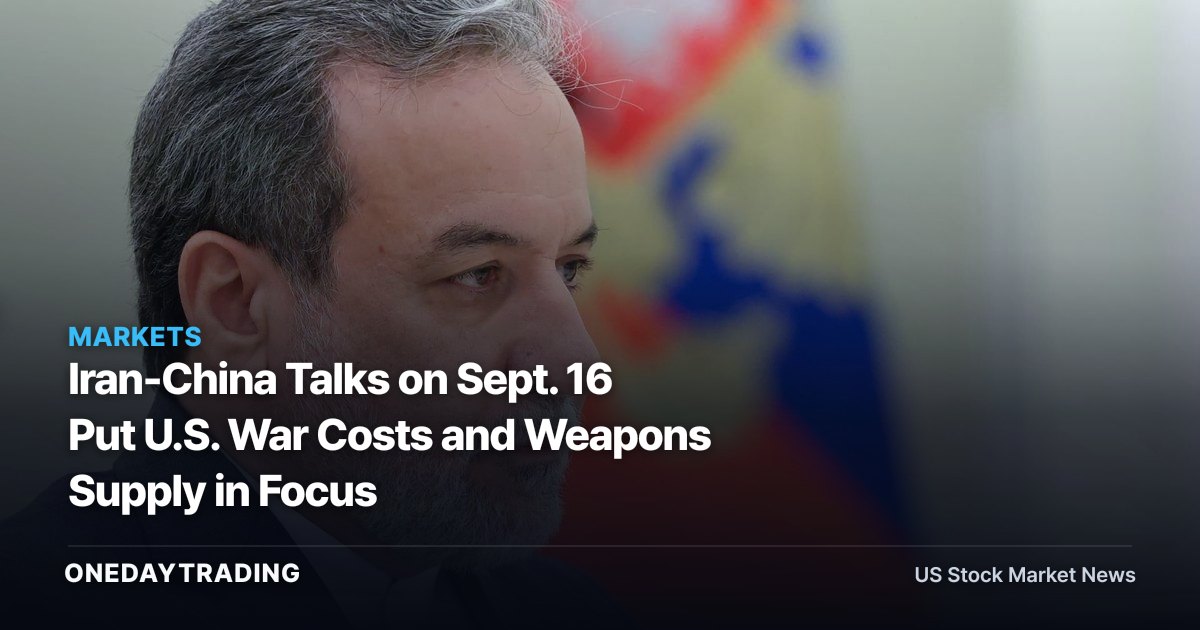
China-Iran Talks Put War Spending Back on the Market’s Radar
For investors, the immediate signal from the Sept. 16 meeting between Iranian Foreign Minister Abbas Araghchi and Chinese Foreign Minister Wang Yi is not a confirmed de-escalation; it is a live diplomatic channel around a conflict that has already produced substantial U.S. financial and equipment costs. China is diplomatically aligned with Iran and economically exposed to the Middle East conflict, so the talks could influence expectations for regional risk, but their specific outcome is unknown.
China’s Ministry of Foreign Affairs announced that Araghchi will visit China for talks with Wang Yi. Beijing has called for a ceasefire and a negotiated settlement that would uphold Tehran’s sovereignty and reopen the Strait of Hormuz. Those stated positions establish the policy framework, not a settlement, and markets still lack evidence that the meeting will change military operations or shipping conditions.
The investment read-through therefore runs through probabilities: a credible diplomatic step could reduce perceived escalation risk, while an inconclusive meeting would leave the reported damage, replenishment constraints and fiscal burden as the more concrete facts. No listed company is identified in the supplied reporting as a direct subject of the talks, so a stock-specific conclusion would go beyond the evidence.
What the Sept. 16 Meeting Can—and Cannot—Resolve
The visit creates a scheduled checkpoint for statements from Beijing and Tehran. Investors can examine whether the two sides describe a ceasefire pathway, a negotiated settlement or steps connected with reopening the Strait of Hormuz. The fact sheet confirms China’s calls for those objectives, but it does not confirm that Araghchi and Wang Yi will reach any agreement.
The diplomatic backdrop is contested. President Donald Trump dismissed reports that Beijing had provided Iran with satellite imagery of a base in Jordan, an allegation linked in the reporting to an Iranian attack that killed three U.S. troops in July. Trump’s dismissal is a position on that report, not evidence that the broader U.S.-China relationship has stabilized.
A second potential checkpoint is an expected meeting between Trump and Chinese President Xi Jinping on Sept. 24. Beijing has not confirmed that meeting, so its occurrence and any agenda remain uncertain. Investors should treat it as a conditional event rather than a scheduled policy outcome.
War Cost Has Become a Budget and Capacity Variable
The U.S. Department of Defense estimated the Iran war cost at $33.4 billion as of June 29, according to CNBC’s reporting on a lead inspector general report to Congress. The same assessment put physical damage to U.S. diplomatic facilities at $184 million across four countries: Iraq, Kuwait, Saudi Arabia and the United Arab Emirates.
Those figures measure more than a single procurement cycle. They combine the direct financial burden of the war with damage to facilities that support U.S. operations and diplomacy. The fact sheet does not provide a forecast for future spending, funding sources or contractor revenue, so the numbers should not be converted into an earnings estimate for any defense company.
The report also said U.S. munitions expenditure produced strategic inventory shortfalls and exposed industrial-base bottlenecks for resupply. That is the key transmission mechanism for the defense sector: operational use can raise replenishment needs, but the pace at which capacity becomes delivered inventory is constrained by the bottlenecks identified in the report. No production timetable, order value or company allocation is supplied.
Aircraft Losses Show the Physical Cost of the Conflict
As of the end of June, Iranian strikes had damaged or destroyed hundreds of buildings and structures at U.S. bases in the Middle East and damaged or destroyed dozens of U.S. aircraft, according to the government report described by CNBC. The quantities are approximate, so they establish scale without providing a precise loss ledger.
The report recorded damage to one fifth-generation F-35A. The U.S. Air Force lists the F-35A at $92 million per plane, although the supplied facts do not say that the aircraft’s full replacement cost equals the listed unit figure or identify the repair bill.
Four F-15E fighter jets and one A-10 ground-attack aircraft were destroyed as of the end of June. The F-15E cost reference in the supplied material is $31.1 million in 1998, a historical baseline that is not an inflation-adjusted current value. Seven KC-135 refueling aircraft were damaged or destroyed, while U.S. forces lost seven helicopters and more than 30 drones.
The mix matters operationally. Fighter losses affect combat capacity, refueling-aircraft losses affect mission support, and drone losses affect lower-cost unmanned operations. The fact sheet does not identify replacement schedules, readiness levels or the contractors responsible for each platform, limiting any company-level inference.
Defense-Industrial Implications Without a Stock Call
For the aerospace and defense sector, the confirmed evidence points to two opposing forces. Combat damage and strategic inventory shortfalls can create demand for replacement aircraft, munitions and support equipment. At the same time, the report’s reference to industrial-base bottlenecks warns that demand does not automatically become near-term shipments or margin expansion.
President Trump said on Truth Social that the United States “is producing more Exquisite and Elite Weapons than at any time in our History.” That quotation is a presidential claim; the government report’s finding of strategic inventory shortfalls supplies a separate, more measurable constraint. Investors should keep those statements distinct rather than treating the slogan as proof of available capacity.
Because no public-company names, contracts, backlogs, margins or guidance figures appear in the supplied facts, the defensible sector view is conditional. The positive case requires evidence that replenishment bottlenecks are easing and that losses translate into funded orders. The negative case is that damaged equipment and depleted inventories remain a fiscal and logistical burden without a disclosed delivery schedule.
Risk Check: Diplomacy, Data Quality and Timing
- The Sept. 16 talks may produce no agreement; the specific outcomes are unknown.
- The expected Trump-Xi meeting on Sept. 24 has not been confirmed by Beijing.
- “Hundreds” of structures and “dozens” of aircraft are approximate quantities, so they cannot support precise damage or replacement calculations.
- The $33.4 billion war-cost estimate and $184 million diplomatic-facility damage figure are measured as of June 29; they do not establish the cost after that date.
What Investors Should Monitor Next
The first observable checkpoint is the official readout from the Araghchi-Wang talks on Sept. 16. Language on a ceasefire, negotiated settlement, Tehran’s sovereignty or reopening the Strait of Hormuz would indicate whether the meeting moved beyond diplomacy as positioning. Silence on implementation would leave the conflict’s financial and capacity effects unresolved.
The second checkpoint is whether Beijing confirms the expected Trump-Xi meeting on Sept. 24. If it occurs, the agenda and any reference to Iran would matter more than the expectation itself. On the defense side, the next useful evidence would be an updated official accounting of inventories, equipment losses or resupply capacity; the supplied report provides no later figures.
Bottom Line
China’s announcement of Araghchi’s Sept. 16 talks with Wang Yi gives markets a defined diplomatic event, but not a confirmed change in the conflict. The harder data are the Pentagon’s $33.4 billion cost estimate as of June 29, $184 million in diplomatic-facility damage across four countries, aircraft losses and reported munitions bottlenecks. A diplomatic breakthrough could improve the regional risk outlook, while an inconclusive meeting would keep fiscal pressure and industrial constraints in focus. Until official follow-up clarifies outcomes and resupply capacity, the evidence supports close monitoring rather than a directional stock conclusion.
📊 Analysis
Signal Neutral
Why The China-Iran talks could affect diplomatic expectations, but their outcome is unknown while the reported U.S. costs and equipment losses show pressure without a clear stock-specific direction.
This article was independently written by OneDayTrading from public reporting. Read the original (CNBC)