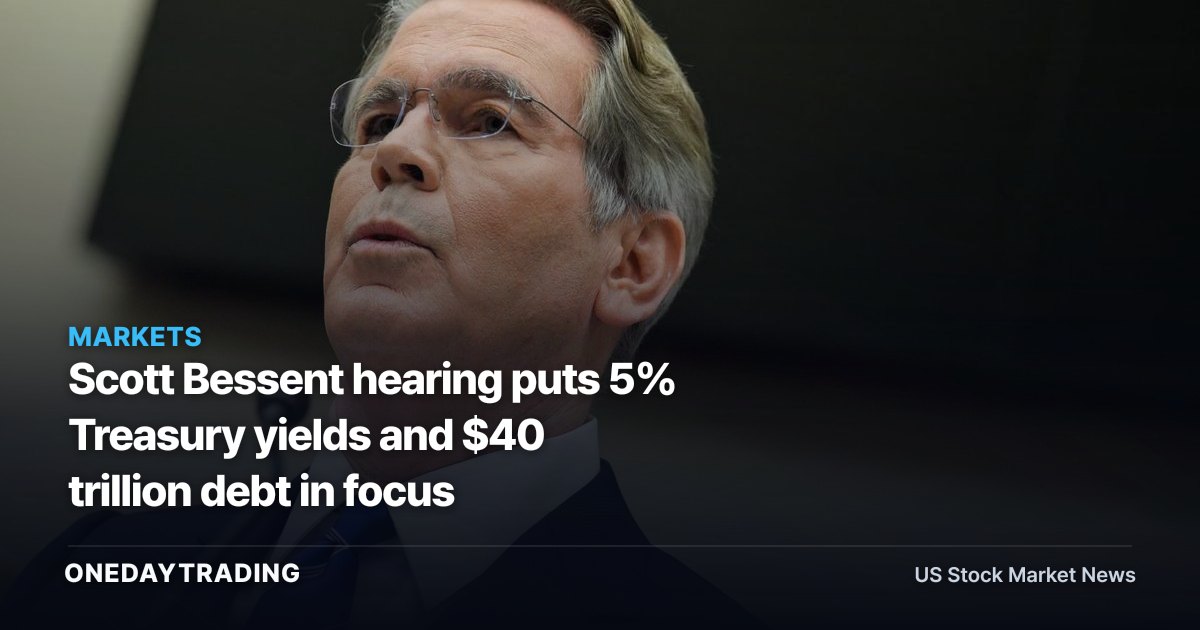
Scott Bessent’s Hearing Puts the 5% Treasury Yield at the Center
Scott Bessent’s Sept. 15, 2026 testimony before the House Financial Services Committee gave investors a clear tension to price: the Trump administration is emphasizing employment, tax cuts and a strong stock market while markets confront a 5% 10-year Treasury note, oil above $100 per barrel and national debt above $40 trillion. Those forces matter because government funding costs flow into mortgages, corporate discount rates and equity valuations, while higher energy prices pressure household and business budgets.
CNBC reported that the annual hearing covered artificial intelligence, inflation, energy prices, interest rates and federal debt. It was also formally part of congressional oversight of the International Monetary Fund, the Washington-based organization established in 1944 to support global financial stability.
Why the Treasury Market Matters for Stocks
The 10-year Treasury note traded at 5% as the Tuesday morning hearing began, and the average 30-year fixed mortgage rate topped 7% last week. A higher risk-free rate can compress the present value of future corporate cash flows, particularly for growth businesses whose expected earnings lie further in the future. It also raises the financing hurdle for companies and households, creating a direct link from Treasury trading to equity multiples and consumer demand.
Maxine Waters, the committee’s ranking Democrat, said, “Despite your feeble efforts, there continues to be a sell-off of U.S. Treasuries.” The Treasury Department had increased purchases of certain long-dated Treasury bonds it viewed as mispriced. Democrats argued that the purchases had not stopped long-term yields from rising; Bessent countered that yields would have been higher without the intervention.
Bessent cited two of the Treasury Department’s most successful bond auctions in 20 years. He also said he was working on deficit-reduction plans and acknowledged that “the need to address the deficit” is one factor reflected in the 10-year yield. The hearing did not provide specific deficit measures, an exact purchase amount or a final assessment of the buyback program, leaving investors to judge the policy through auction demand and subsequent long-dated yields.
Oil, Gasoline and the Household Transmission Channel
Energy prices add a second pressure point. Oil was trading above $100 per barrel recently as the conflict involving the Islamic Republic of Iran intensified. U.S. gasoline averaged $4.32 per gallon as of Monday, up $1.14 per gallon from a year earlier, while diesel reached $6.23 per gallon, an increase of $2.54 over the same period.
For consumers, fuel is an immediate reduction in disposable income. For transport, manufacturing and other fuel-intensive businesses, diesel and gasoline raise operating costs before any pricing response appears in revenue. That mechanism can make energy producers such as Exxon Mobil and Chevron relative beneficiaries of higher crude prices, while leaving the broader market exposed to weaker consumption or narrower margins. The supplied evidence does not identify an exact oil price, explain the cause of the reported moves or establish how long the energy shock will last.
Bessent supports the war and his department has increased sanctions on Iran and banks facilitating its business. He framed economic strength as enabling what he called “the greatest economic isolation campaign in the history of the world” against Iran and its enablers. For markets, the relevant variable is whether sanctions and conflict keep crude prices elevated enough to sustain inflation and Treasury-yield pressure.
AI Security Becomes Part of the Fiscal and Strategic Debate
Artificial intelligence appeared in the hearing as both a technology-risk issue and a national-security concern. Bessent said Chinese companies are a greater threat than U.S. firms. He also stated, “Kimi had a breach and sent Chinese weapons plans back to Anthropic.” Anthropic, the creator of Claude, did not immediately respond to a request for comment about the remarks.
The fact pattern is narrow: Kimi is described as a Chinese AI model that allegedly routed some users’ queries to Anthropic, and no further details about the alleged breach were provided. Investors should therefore separate a political assertion from verifiable operating data. The hearing supplied no figures on AI revenue, infrastructure spending, security losses or regulatory action that would support a company-specific earnings conclusion.
AI spending was nevertheless cited alongside debt supply and higher oil prices as a factor associated with increased government funding costs. That combination matters for valuation: capital-intensive investment can compete for financing at the same time that Treasury issuance sets a higher benchmark rate. Whether that becomes a durable constraint depends on future auction demand, deficit policy and the path of energy prices.
What the Administration Highlights—and What Markets Still Test
House Republicans and Bessent emphasized positive aspects of the Trump economy. The S&P 500 was up about 27% since Trump took office for his second term, and unemployment stood at 4.1%. Bessent said wages for the bottom 25% of earners had risen faster than those of the top group. More than 64 million tax returns had claimed one of the tax cuts passed last year.
Those figures support a demand-side case for resilience, but they do not erase the rate-sensitive risks. A 5% 10-year note and mortgage rates above 7% can weigh on housing and financing even while employment remains strong. The market is therefore balancing realized economic support against the possibility that debt service, oil and higher discount rates weaken future growth.
The S&P 500’s advance also does not identify which sectors can absorb the rate and energy shock. Oil producers have direct commodity exposure, while companies dependent on borrowing or discretionary spending face a different transmission path. Without company-level earnings, guidance or valuation data in the hearing record, sector conclusions remain conditional rather than directional calls.
Next Checkpoints for Rates, Energy and Risk Assets
- Long-dated Treasury auctions: Track demand and subsequent yields after the Treasury Department’s purchases of selected bonds. Bessent’s claim about two highly successful auctions needs confirmation in the market’s reaction.
- Deficit policy: Watch for concrete deficit-reduction measures. Bessent said plans were in progress, but the hearing supplied no details or timetable.
- Energy prices: Monitor whether oil remains above $100 per barrel and whether gasoline at $4.32 per gallon and diesel at $6.23 per gallon continue rising from their reported levels.
- Rate-sensitive assets: Compare the 10-year Treasury note near 5% with mortgage costs and equity performance. A further rise would increase the valuation pressure already visible in borrowing markets.
Investment Outlook After the Bessent Testimony
The hearing leaves investors with a mixed macro signal. Strong employment, reported wage gains among lower-income earners, tax-cut participation and a 27% S&P 500 gain argue that economic activity has held up. Higher Treasury yields, a national debt above $40 trillion, oil above $100 per barrel and sharply higher fuel costs point to a more expensive path for financing and consumption.
The bullish case rests on continued labor-market resilience and successful Treasury funding, with energy producers potentially benefiting if crude prices stay elevated. The risk case is that unresolved deficit pressure and persistent energy inflation keep the 10-year yield high enough to compress valuations and raise household costs. The next observable evidence will come from Treasury auctions, any specific deficit proposals and the direction of oil, mortgage rates and the S&P 500.
📊 Analysis
Signal Neutral
Why The hearing presented competing signals: strong equity performance and employment alongside higher borrowing costs, energy prices and unresolved deficit pressures.
This article was independently written by OneDayTrading from public reporting. Read the original (CNBC)