Federal Reserve Vote Puts the Market’s Confidence Test on Wednesday
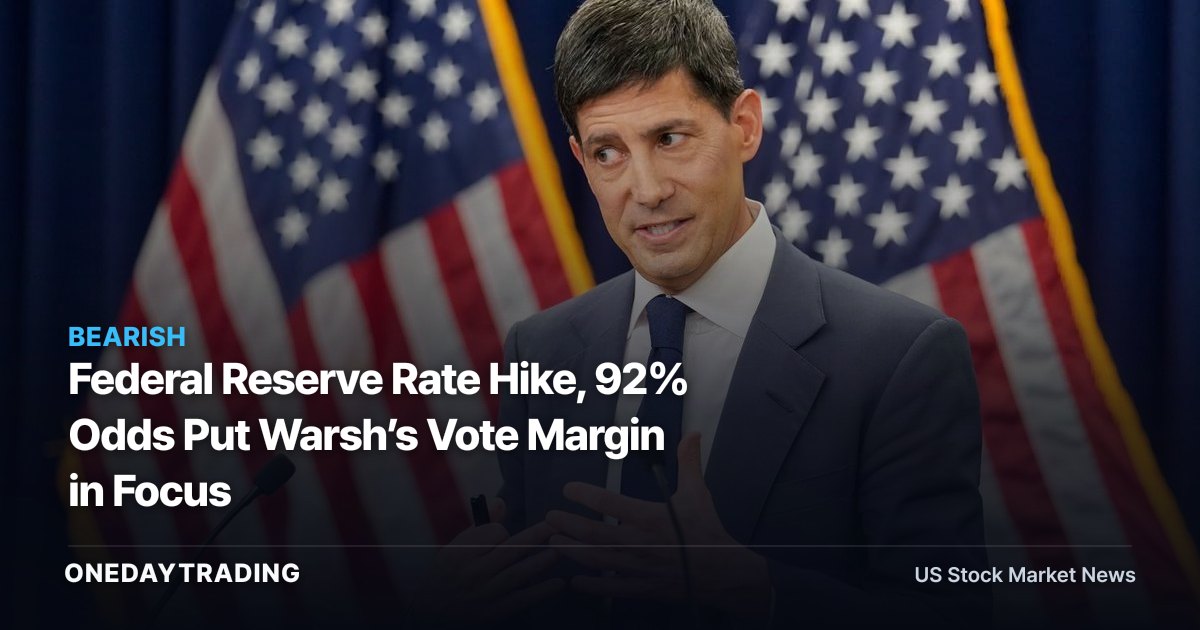
U.S. equity investors face a policy decision that is nearly priced but not yet fully understood: futures traders assigned a better than 92% probability to a Federal Reserve rate increase this week, while the final vote margin remains unknown. The Federal Open Market Committee’s 12 voters must decide whether a quarter percentage point hike is a one-meeting response or the start of a broader cycle, a distinction that can move valuation multiples and leadership across rate-sensitive sectors.
The federal funds rate currently stands at 3.50% to 3.75%. A hike would therefore tighten the policy setting immediately, but the larger market signal may come from how many officials join Kevin Warsh and the three policymakers who previously favored higher rates. Investors are also pricing a more than 75% probability of another FOMC move in December, so the communication around this week’s decision matters as much as the mechanical 25-basis-point adjustment.
What the 92% Probability Does—and Does Not—Settle
The CME Group’s FedWatch gauge supplied the stated market probabilities. Bill Dudley, the former New York Fed president, argued that with markets positioned this way, it would be “shocking” for Warsh to do nothing because inaction could damage the chair’s credibility. That is a market-positioning argument, not confirmation that the Federal Reserve will raise rates; the decision and the exact number of dissenters remain unknown.
The July FOMC meeting ended with a 9-3 vote to hold rates. Lorie Logan of Dallas, Beth Hammack of Cleveland and Neel Kashkari of Minneapolis were the three dissenters, and each had supported a quarter-point hike two months earlier. If their positions are unchanged, four additional members would need to move from hold to hike for a majority increase, making the head count the central variable for Wednesday’s market reaction.
Christopher Waller is a key swing point. In remarks delivered Sept. 3, he supported another hold, emphasizing that waiting one meeting and hiking 25 basis points now would not itself bring the Consumer Price Index to the Federal Reserve’s 2% inflation target. John Williams, whose New York Fed position is traditionally viewed as part of the central bank’s influential troika, also said a “wait-and-see” approach made sense.
Inflation Data Leaves Two Plausible Policy Readings
August CPI showed headline inflation at 3.4%, while core inflation was 2.4%, down 0.1 percentage point from July. The split gives both camps evidence: headline pressure remains above the 2% target, yet the core measure eased at the margin. Lisa Cook said she was prepared to act against inflation, while Michael Barr said he was open to a hike but not set on one.
Goldman Sachs economist David Mericle wrote that there was no strong economic case for raising the funds rate because the overshoot could reflect one-time factors. Goldman nonetheless changed its call from no change to a hike, primarily because market expectations could force the Federal Reserve to move. That change highlights the tension investors must separate: the economic case for a hike is contested, while the credibility cost of ignoring a heavily priced decision is already part of the market debate.
Anna Paulson of the Philadelphia Fed and Austan Goolsbee of the Chicago Fed have counseled patience. Philip Jefferson, Jerome Powell and Michelle Bowman remain less clearly aligned in the supplied evidence. Their positions, together with Warsh’s own preference for limited forward guidance, leave the final margin—and the policy signal attached to it—unresolved.
Why the Vote Margin Matters for Stocks
- Banks and financials: A higher federal funds rate can support lending yields in the near term, but the stock-market effect depends on whether investors interpret the move as a contained adjustment or the beginning of repeated increases. JPMorgan and Goldman Sachs are directly tied to financial-market conditions, yet the supplied evidence does not establish a company-specific earnings outcome.
- Broad equity multiples: Rate-sensitive valuation models generally apply greater discounting when policy rates rise. If the hike is accompanied by a narrow vote and cautious guidance, that pressure could be limited; a broad coalition favoring additional increases would present a tougher multiple backdrop. The source does not provide an index level or a confirmed market move.
- Interest-sensitive sectors: Companies and sectors whose valuations depend heavily on future cash flows may react more to the December probability and the dot plot than to the first quarter-point move itself. This is a conditional mechanism, not a reported sector result.
Investor Checkpoints for the FOMC Release
- Count the dissenters: Compare the final decision with July’s 9-3 hold vote. The exact final margin is unknown, and a move toward two, one or no dissents would indicate how far the committee has coalesced.
- Read the statement and news conference: Warsh must explain whether the action is one-and-done, part of further increases or deliberately noncommittal. In a close division, his Wednesday afternoon message becomes the main transmission channel to markets.
- Track the December pricing: Futures had assigned more than 75% probability to another FOMC move in December. That probability can change if officials frame this hike as exceptional rather than the start of a sequence.
- Study the dot plot: The update covers 19 participants, includes outlooks for 2027 and offers the first look at 2029. Investors will focus on conviction around two hikes this year, while recognizing that the dot-plot outcome is not yet known.
Outlook: A Priced Hike, an Unpriced Debate
The bullish interpretation for equities is that a quarter-point increase could remain a contained response to inflation readings, especially with core CPI at 2.4% and down from July. Under that scenario, a restrained vote margin and patient guidance would reduce the risk of a rapid tightening cycle, even though the federal funds rate would move above its current 3.50% to 3.75% range.
The risk case is a majority that treats higher inflation as the beginning of a series. David Mericle noted a possible 10-8 split in favor of one hike, while also identifying a risk that more participants could see higher oil prices and AI demand as reasons for two hikes this year. Those are scenarios, not outcomes. The final FOMC vote, Warsh’s explanation and the 19-person dot plot will determine whether markets continue to treat December as likely or begin removing that expectation.
For investors, Wednesday’s decision is therefore a test of policy cohesion rather than a simple rate event. The next observable signals are the vote margin, the chair’s description of the path beyond one meeting and the updated projections for 2027 and 2029.
📊 Analysis
Signal Bearish
Why Higher policy rates can pressure equity valuations and interest-sensitive sectors, while the unresolved vote margin keeps the market path uncertain.
This article was independently written by OneDayTrading from public reporting. Read the original (CNBC Markets)