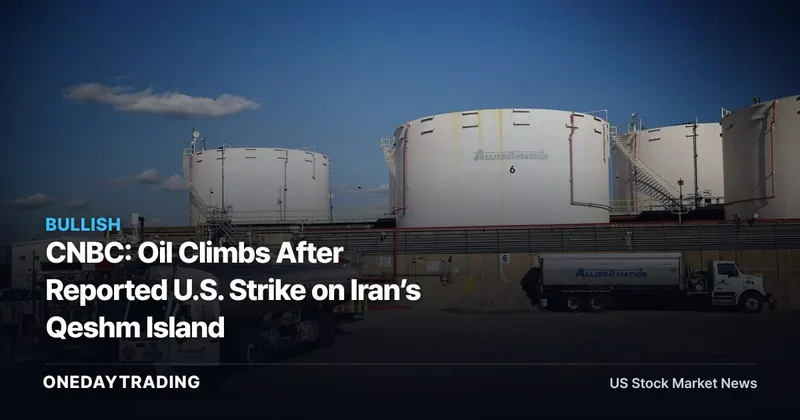
CNBC reported that oil prices climbed on Tuesday after the U.S. reportedly struck Iran’s Qeshm Island late Monday. The immediate signal for investors is bullish for oil itself, although the available evidence does not establish a company-specific effect or a durable price direction.
Brent crude rose 1.75% on Tuesday to $106.60 per barrel, according to CNBC. West Texas Intermediate advanced 1.7% on Tuesday to $98.10 per barrel, the same report said. Those moves followed a decline of over 7% in oil prices on Monday, placing the latest advance inside a sharp sequence of conflicting market signals rather than a settled trend.
The Qeshm Island development is a reported U.S. military action whose precise timing and scope remain unconfirmed in the supplied evidence. For investors, that distinction matters: the market has a reported strike, observable oil-price moves and public diplomatic language, while the future course of the conflict and oil prices remains unknown.
CNBC’s Qeshm Island Report Reopens the Oil Question
U.S. officials told The Wall Street Journal that Washington attacked Iran’s Qeshm Island on Monday, as relayed in CNBC’s account. The report characterized the wider activity as “limited strikes,” but the identity of the official cited about the military campaign was not disclosed.
The evidence therefore supports a narrow conclusion. Oil rose after the reported Qeshm Island action, and the military report became the latest fact investors had to weigh. It does not establish the full scale of the operation, prove what comes next or show that Tuesday’s advance will persist.
Brent crude had already reached its highest level since 2022 before the reported development. That earlier positioning makes the Tuesday move especially important to interpret with discipline: the price was elevated before Qeshm Island entered the account, so the latest report cannot explain the entire preceding rise.
The sequence also cautions against treating one session as a complete verdict. Monday’s decline of over 7% in oil prices came as the U.S. and Iranian presidents signaled openness to a diplomatic solution. Tuesday then produced gains in both major crude benchmarks after the reported strike. The tape is reflecting competing developments, not confirming which one will dominate.
JD Vance and Marco Rubio Keep Diplomacy in the Price Debate
The military report is only one side of the evidence. JD Vance told CNN that he and the president felt good about the possibility of reaching a negotiated settlement. Marco Rubio separately said Donald Trump wanted to resolve the Iranian war diplomatically and preferred not to use military force.
Those statements do not establish that an agreement will be reached. They do establish that public support for negotiations remained present alongside reports of military action. The central market tension is therefore not simply escalation versus calm; it is the coexistence of reported strikes and declared openness to diplomacy.
Monday’s move shows that diplomatic signals can coincide with a substantial repricing of oil. Tuesday’s rebound shows that a subsequent military report can interrupt that direction. Neither observation supplies a reliable forecast, yet together they identify the live variable: whether the next confirmed development strengthens the negotiation track or broadens the reported military track.
Attribution is essential here. JD Vance’s assessment describes the administration’s confidence in the prospect of negotiations; it is not evidence of a completed settlement. Marco Rubio’s statement describes Donald Trump’s preference for a diplomatic resolution; it is not confirmation that military activity has ended.
Brent and West Texas Intermediate Send a Qualified Bullish Signal
- Brent crude: CNBC placed Brent at $106.60 per barrel on Tuesday after a 1.75% gain. The move is bullish for the commodity on the session, while the prior decline and unresolved conflict outcome limit what can be inferred beyond that period.
- West Texas Intermediate: CNBC reported West Texas Intermediate at $98.10 per barrel on Tuesday, up 1.7%. Its direction matched Brent’s, giving the rebound confirmation across both benchmarks without proving a lasting advance.
- Oil-linked equities: The fact sheet names no listed producer, refiner, transporter or consumer and provides no operating exposure. Assigning winners, losers or U.S.-listed tickers would therefore require facts outside the permitted evidence.
The cleanest market read is that oil regained part of Monday’s decline after the reported Qeshm Island strike. Calling the move a confirmed new trend would go beyond the data. So would claiming that diplomacy has removed the military risk: the settlement remains a possibility, not an outcome.
This is also why the commodity signal is clearer than the equity signal. The supplied prices directly measure Brent and West Texas Intermediate, whereas no company revenue mix, cost structure, production exposure or guidance is provided. The evidence can support a directional judgment on oil, but not a defensible stock-specific call.
What Oil Investors Need to Confirm Next
- The reported operation: Look for confirmation of the precise timing and scope of the Qeshm Island strike. The current account establishes that U.S. officials described an attack, while leaving those operational details unresolved.
- The negotiation track: Test future statements against the positions already expressed by JD Vance and Marco Rubio. The meaningful change would be evidence that diplomatic openness has advanced toward a settlement or receded.
- The two benchmarks: Compare the next observable direction in Brent crude and West Texas Intermediate. A shared move would offer stronger commodity-level confirmation than either benchmark moving alone, though it would still not determine the conflict’s outcome.
- The reported military track: Distinguish another account of “limited strikes” from evidence of a change in scope. The supplied facts do not resolve whether future action will remain limited.
The bullish case is confined to what the market has already shown: Brent crude and West Texas Intermediate rose on Tuesday after the reported U.S. strike. The countercase is equally concrete: oil prices had fallen over 7% on Monday as the U.S. and Iranian presidents signaled openness to diplomacy.
The next decisive input is not a forecasted price target. It is confirmation about the strike’s scope and evidence about whether negotiations are progressing. Until either arrives, the oil market’s message is specific but provisional—Tuesday favored higher crude prices, while the conflict and diplomatic outcomes stayed unresolved.
📊 Analysis
Signal Bullish
Why Brent crude and West Texas Intermediate both climbed on Tuesday, giving the immediate directional signal for oil despite unresolved diplomatic and military outcomes.
This article was independently written by OneDayTrading from public reporting. Read the original (CNBC)