Summary
AI data centers are creating a direct freight tailwind for truckers because the facilities require large volumes of HVAC equipment, tubing, wiring and semiconductors delivered primarily by road. The boom matters to transportation investors because it links artificial-intelligence capital spending to physical trucking demand, even as trade wars have battered the broader freight business.
Truckers therefore see AI infrastructure differently from Americans focused on software and chips: data-center growth is arriving as revenue-generating loads, not just an abstract technology trend.
The Full Story
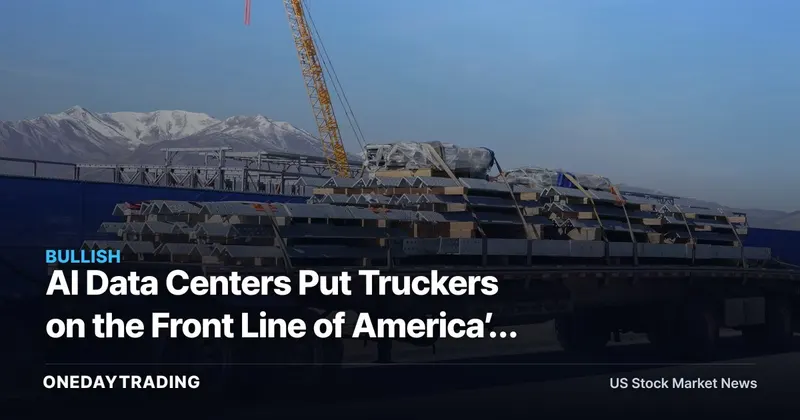
AI data centers are specialized computing facilities built to run artificial-intelligence workloads, and their construction depends on coordinated shipments of cooling, electrical and semiconductor components. CNBC reports that sprawling data-center parts move mainly by truck, turning each new project into a sequence of freight opportunities for carriers and drivers.
That cargo mix is strategically useful. HVAC systems and tubing are bulky industrial loads; wiring adds additional equipment volume; semiconductors add high-value freight tied to the same buildout. Trucking captures the final inland movement across these categories, so stronger data-center construction can lift demand even when conventional freight remains under pressure.
The contrast with the rest of America is the investment signal. Public enthusiasm for AI often centers on model developers and chip designers, while truckers experience the spending through dispatches, lanes and equipment deliveries. CNBC describes the resulting business boom as a boon for an industry hit hard by trade wars, suggesting that domestic construction is offsetting at least part of trade-related weakness.
Structural Background
Data-center expansion requires physical capacity before computing revenue appears. Cooling hardware controls heat, wiring connects power and data, tubing supports those systems, and semiconductors populate the servers; each component must reach the site in sequence. Because the source identifies trucking as the primary transport mode, freight availability is a critical link between AI investment plans and transportation results.
The risk is concentration. If data-center orders become the dominant bright spot while other freight categories remain weak, carriers could gain volume without broad-based pricing power. Trade-war effects also remain relevant because imported components, routing changes or delayed projects can interrupt the load pipeline.
Stock & Sector Ripple
- Trucking and logistics: Data-center deliveries provide incremental industrial freight for carriers serving construction and technology corridors, helping an industry damaged by trade wars.
- Transportation equipment: Sustained component movements can support utilization of tractors, trailers and specialized hauling capacity, but the source gives no evidence of fleet orders or margin expansion.
- HVAC suppliers: Cooling systems are a named component of the buildout, making commercial climate-control demand a direct physical read-through from AI infrastructure spending.
- Electrical and wiring supply chains: Wiring and tubing add non-semiconductor cargo, broadening the freight effect beyond server chips alone.
Bull vs Bear Scenarios
The bullish case is that AI data-center construction continues to scale, creating recurring truckloads across cooling, power and computing hardware. That would give transportation companies a demand source less exposed to the trade-war shock that hurt their traditional business.
The bearish case is that the boom remains narrow or projects slow. Trucking could then face concentrated demand without enough economy-wide freight to improve pricing, while component delays tied to trade friction could reduce shipment visibility.
Investor Action Points
- Track carrier commentary on data-center and construction loads in the next earnings cycle.
- Watch whether freight demand broadens beyond AI projects into general industrial volumes.
- Monitor trade-policy developments for signs of component delays or rerouted supply chains.
- Compare shipment growth with utilization and pricing metrics; volume alone does not prove margin recovery.
FAQ
Why are AI data centers helping truckers?
AI data centers require HVAC systems, tubing, wiring and semiconductors, and CNBC reports that these components arrive primarily by truck. Each facility therefore generates physical freight demand alongside its computing capacity.
What parts do data centers ship by truck?
The source names HVAC equipment, tubing, wiring and semiconductors as major components moving to sprawling data centers. These loads span industrial systems and high-value electronics.
Can data-center growth fix the trucking downturn?
AI construction is described as a boon for trucking after trade-war damage, but the source does not establish industrywide recovery. Investors must test whether project freight improves utilization and pricing across the next reported results.
📊 Analysis
Signal Bullish
Why AI data-center construction is generating truck-delivered component demand that offers the trade-war-hit transportation sector a concrete business tailwind.
This article was independently written by OneDayTrading from public reporting. Read the original (CNBC)