
Summary
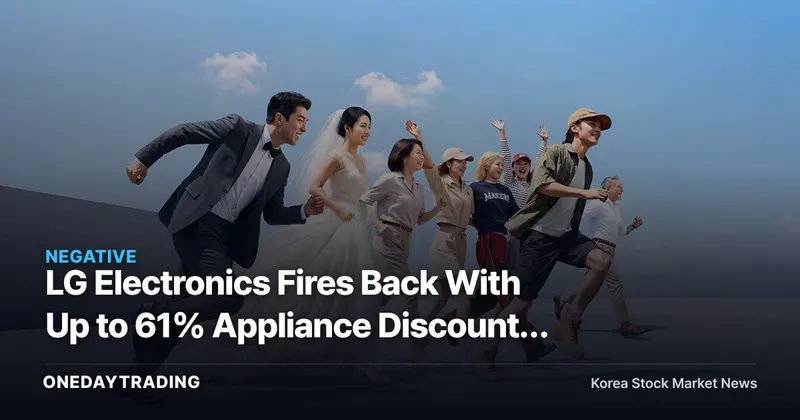
LG Electronics has gone head-to-head with Samsung Electronics' "Thank-You Festival" by launching the "National Team Appliances, People's Cheer Grand Festival," which returns 20% of the purchase amount in digital Onnuri gift certificates and offers discounts of up to 61%. On the surface it looks like an expansion of consumer benefits, but from an investor's perspective it reads as a signal of a bruising price war in which the No. 1 and No. 2 players are ramping up discounts at the same time, just as domestic appliance demand has turned down.
The key question is "how much profitability is being given up to defend sales volume." While the promotion may prop up the top line (revenue), it is important to also recognize that the accompanying rebate and discount costs come back as a burden on the operating margin of the home appliance (H&A) division.
The Full Story
LG Electronics has rolled out a company-wide promotion that pays back 20% of the purchase amount in digital Onnuri gift certificates and cuts prices on some items by up to 61%. With the campaign branded "National Team" and "People's Cheer," it carries a strong marketing flavor aimed at consumer sentiment during the sports-event season.
This event is read as a direct counter to the large-scale Thank-You Festival run by Samsung Electronics. The structure is such that when one side mounts aggressive discounts, the other has little choice but to respond to stem any loss of market share — in effect, both companies have simultaneously played the price card.
Structural Background
Korea's domestic appliance market has seen its growth engine weaken amid a slump in real-estate transactions and slowing replacement demand. When new demand is limited, companies place more weight on "clearing inventory" and "holding market share" than on charging a premium for new products — and the tools for that are discounts and paybacks. The Onnuri gift-certificate rebate scheme can be seen as a device that secures justification by aligning with the government's push to stimulate domestic consumption, while amplifying the effective discount.
Stock and Sector Ripple Effects
- LG Electronics: The event's host. There are expectations of a short-term boost in revenue and traffic, but rebate and discount costs could pressure the margin of the H&A (home appliance) division, so the top line and profitability may move in opposite directions.
- Samsung Electronics: The counterpart. While appliances (DA) make up a small share of overall company earnings, repeated discount wars are a common drag on the profitability of the domestic appliance segment.
- Appliance retailers such as Lotte Hi-mart and Electroland: The promotions by both companies could lift offline and online appliance sales traffic, serving as a short-term boost to customer counts for distribution channels.
- Appliance component and set suppliers: Higher sales volume could pull through more component orders, but there is also the possibility that the set makers' pressure to cut unit prices is passed on to suppliers.
Bull vs. Bear Scenarios
Bull case: The aggressive promotions could stimulate sluggish domestic demand, rapidly clear inventory, and defend market share, easing the burden of second-half new-product launches. If top-line growth is confirmed, cost concerns are partly offset.
'Bear case: When the No. 1 and No. 2 players cut prices at the same time, discounting quickly becomes "cutting into one's own flesh." Even if sales volume rises, per-unit profit shrinks, risking a setback in the appliance division's operating margin, and rebate costs flow straight through to quarterly earnings. If demand itself does not recover, a sales vacuum after the event ends (a reverse base effect) is also a variable.
Investor Action Points
- In next quarter's earnings, check the change in LG Electronics' H&A division "operating margin relative to revenue growth rate" together, to gauge whether the top line and profitability have diverged.
- Compare against Samsung Electronics' DA segment to assess which side's margin the discount war eroded more.
- Use sales trends and inventory-level commentary right after the promotion ends to distinguish between genuine demand stimulation and simply pulling demand forward.
- Track domestic consumption indicators (appliance retail sales) and housing transaction-volume trends to monitor whether appliance demand is structurally recovering.
LG Electronics Through Real-Time Data
LG Electronics' latest closing price is 210,000 won (-7.69% from the previous day), and the signal light — combining foreign and institutional investor supply-demand (order flow) with news and momentum — is 🟡 Neutral · Wait-and-See. Positive and negative signals are mixed, marking a stretch to watch.
- ▼ Trend Alignment — Short- and mid-term downward alignment (intraday -7.7% · 1-week -10.3% · 1-month -10.6%)
- ▲ News Flow — 4 positive catalysts vs. 0 negative catalysts — positive catalysts have the edge
Recent related news is favorable, with 4 positive catalysts and 0 negative catalysts.
※ Price and foreign/institutional investor supply-demand (order flow) data are provided by Korea Investment & Securities (KIS), as of the time of publication.
This article is content automatically summarized and analyzed based on the original news. View original (Maeil Business Newspaper, Corporate)